Wednesday, March 20, 2013

Manzanares El Real

     On Saturday, Jack, Katie and I took a bus to the small town of Manzanares El Real, 45 minutes north of Madrid by bus. Our main goal was to do some hiking, which was threatened by morning rain. But when we arrived, the rain was a drizzle, and after breakfast we headed for the rocks.


     On the way was an old hermitage built in the 14th century.


After stopping for some tapas at a bar on the road that dead-ended into the rocks, we started the real hike. The town is so named because the Manzanares river runs through it. This is the same river that runs through Madrid. Apparently once in Manzanares El Real one can hike a few hours to the source of the river, which we would like to do one day.

(The Manzanares River)

     The hiking path offered unexpected views of the snow-capped Guadarrama mountain range in the distance. 


     The main trail follows the river, and assumedly goes on for a long time. We were hiking in what is called La Pedriza, which is a part of the Cuenca Alta park. La Pedriza is famous for its eroded rock formations, some of which we saw, but many will have to wait until next time we visit. There are a ton of trails to hike. Rain was threatening all day, and since we had already walked a couple of miles to the trailhead, we decided not to walk too many more miles into the park. 

(Cover to future Rock album)

     After the hike, we walked around the "new" castle of Manzanares, which was begun in 1475. It is one of the best preserved castles around. 

(New Castle of Manzanares El Real)

     En fin, it was a very nice, low budget trip, easily reached on a city bus. We will definitely be returning to explore La Pedriza more extensively. 

(The hermitage— Photo by Katie)
   

Monday, March 11, 2013

Jane Goodall In Madrid

     Each week a teacher at school gives me magazines that contain weekly happenings in Madrid. So a couple of weeks ago, when I read that Jane Goodall would be speaking at the National Geographic store here in Madrid, I knew what Katie and I would be doing that Wednesday evening.
     Ms. Goodall was in Madrid to accept an award, and while she was here, she gave a talk at National Geographic, the first organization to fund her in the 1960s. During the talk, which lasted over an hour, she told the story of how she got started researching chimpanzees, her challenges and successes, and the importance of animal and environmental protection. She recounted how, with no professional experience or degree, she went to Tanzania to study chimpanzees, and quickly made discoveries that surprised experts in the field. She told of her awe the first time she saw a chimp de-leave a stick and use it as a tool by dipping it in an ant hole for a meal.
     Louis Leaky, the man who made it possible for Jane to study the chimps, also got her into Cambridge to pursue a doctorate in Ethology (the science of animal behavior). While there, her professors told her she was doing everything wrong, and were very doubtful of her observations. Upon her return to Tanzania, she did not change her methods, and one of the chimps began letting her follow him around. One day she followed him through the forest, lost him briefly, only to find him waiting for her to catch up. She then offered him a fruit, which he put down on the ground and then squeezed her hand. Jane had added a whole new dimension to science— compassion for the subject.
    Later in the talk she spoke about conservation efforts and some of her philanthropic organizations and projects. One of her programs, called Roots & Shoots, helps children in Africa and around the world by getting them involved in service projects and campaigns to help conserve the environment. Her overarching organization, the Jane Goodall Institute, is a non-profit organization designed to further conservation efforts of apes and animals.
     She ended by talking about why she was still hopeful that we could save the planet, even though so much damage has been done in recent years. Her biggest reasons were the ability of the human spirit to triumph in the face of adversity, and that it is not only for altruistic reasons that we should save the environment, but also because its destruction will have negative effects on humans as well as other animals. It was an engrossing talk, and time well spent. Here is a link to a short five minute video about her research with the chimps in Tanzania during the '60s, with some really cool footage of her interaction with the apes there. At almost 80 years old, she is still traveling around the world to further her cause, and along the way is helping not only animals and the environment, but children as well. She's all good.

Friday, March 8, 2013

Pedro Almodóvar — Los Amantes Pasajeros

     A couple of months ago I mentioned I had watched a Pedro Almodóvar movie. It was not the first one I had watched, but was the first I had watched without subtitles. It was a personal accomplishment, and a good movie. A few weeks ago I saw another one of his movies, that I didn't enjoy as much, but which was still worth my time. Others I had previously seen include Mujeres al borde de un ataque de nervios (Women On The Verge Of A Nervous Breakdown) and Volver. I recommend both of them. If you're American and you've seen only one of his movies, it's probably Volver (you know, with Penélope Cruz).
     Almodóvar, Spanish writer and director, is like the Woody Allen of Spain, but more famous here than Allen is in the States. He's sometimes funny, often strange, and always distinguishable. Half of Spain loves him, half couldn't care less. Or at least that's what my Spanish friends say. Anyways, I like him, so when I saw he was coming out with a new movie, I decided to go see it.
     Jack, my British friend who works at the same school as I do, is very into film and also likes Almodóvar, so we went to see it together last night. The new film is called Los amantes pasajeros (in English it's titled I'm So Excited, which is not a translation, just a different title, taken from a song in the movie.) Almodóvar has said that this is his last film, and that he is retiring. It is a comedy about passengers and crew on a flight from Madrid to Mexico (though the plane has problems so they just fly around in circles over Toledo, Spain while they wait for somewhere to land). The movie is in many ways an allegory about the economic crisis here in Spain.
     We arrived at the theatre a bit early to buy tickets. Most tickets were sold out, because it was the pre-release screening. As in, it was the first time any public audience had seen the film. We were just about to buy tickets for the 9:30 showing when two people asked us if we wanted two tickets for free, because they had extra. Um, yes, of course. So we went in, took our seats and waited. Jack noticed there were people crowded outside the doors of the theatre and wondered why. Then the doors opened and out came Almodóvar, along with most of cast of the film. It was a big surprise, and he proceeded to introduce the film and pass the microphone to the cast members, who hoped we would enjoy the film.
It was a very unexpected experience, and very unlike Hollywood screenings, where the list of guests is reserved for the rich and famous. And we weren't the only ones who were surprised. The whole thing was a secret, as the news reported later.

     It was really a treat, and the film was very entertaining as well. And needless to say, I will be watching more Almodóvar films in the near future.                                                        
     
(Almodóvar. Picture courtesy of Jack and his phone.)  

Monday, March 4, 2013

Published In Madrid


     When I write, I always write with the intention of producing something good. Now, I need to clarify a couple of things. By writing, I mean writing songs, poetry, and music. This blog, while I have every intention to make it a good read, does not undergo the same process as my songs, poetry, and music. And I realize that 'good' might very well be subjective. So by good, I mean something which passes my standards of good art, and if I can help it, pass the even higher standards of what Katie believes is good art. But always, I write for myself, in order to produce something of which I will approve.
     There are times when I not only write with this purpose, but also with an additional purpose which doesn't conflict with my main intention. That is to publicize and publish my work. This carries a third purpose, which I will get to later. But now, to the publishing bit. Over the past few weeks, I have had three poems published in a local online literary journal based here in Madrid. The journal, called Toast Madrid, was started by a Chicago native who also owns a café of the same name. He hosts poetry nights, and invited me to go last week to read a couple of my poems. It was a great time, and nice to meet some people with at least one common interest. I also told him I played music, and he told me to send him my music, and now wants me to play a show at the café later this month. This is good.
     So, the poems— the subject matter deals with Retiro park here in Madrid, which I frequent. In January, I was finding it difficult to write, and Katie suggested I do a study on something specific in order to set some boundaries for my writing, which sometimes helps with focusing and producing more frequent successes. Well, like usual, she was right. So the three poems published were inspired by the park, and I am continuing with my study. The three poems are called "Slices," "Creates The Air," and "Two Women Talking." You can find them all HERE, or click on the individual poems.
     But you don't get poems published unless you submit them. So there must be a reason why all of a sudden I submitted some poetry. And there is. And this reason also does not conflict with my foremost purpose of writing, but is designed to enable more writing. Oddly, if you want to go to school in the States, you have to apply darn near a year in advance. I am thinking about doing a Masters in poetry— not this Fall, but the next one, which means I will need to submit an application at the end of this year. These programs are highly competitive, and not too many offer full scholarships and stipends. The main criteria for being accepted (so I'm told) is the work you submit. But apart from that, they look at other things, including if you have been published, how many times, etc. And so I am doing my best not only to write a lot, but also to publish. Having these poems published is encouraging, and lets potential universities know that other people think your work is good enough for others to see. I am planning on submitting poems in the next week to many journals in hopes of more good news.
     Of course, I can't be sure I want to do an M.F.A. in poetry, but it seems pretty good to me. And I know some people will say I am avoiding "real" work, and maybe for some people I am, but the thing is, this is real work for me. Just because I don't want to work a 9 to 5 office job doesn't mean I don't want to work 9 to 5 on something (ex: writing). And so, I continue trying to make the most of my time here, and hopefully I will come away with much more than memories.

Monday, February 18, 2013

Cultural Differences, Part 1: Time

     Before arriving in Spain, I imagined it would be for the most part very similar to the United States. And it is, for the most part. It is a first world, western democratic-ish country. But as I began to settle in, I noticed more and more quirks that really make life here different than life in America. For my first installment of "Cultural Differences," I will focus on the peculiarities of Spain's perception of Time, at least from an American's viewpoint.

Eating: Spaniards eat nothing or very little for breakfast. They do this at the normal time of day, 7 or 8 o'clock on weekdays. Then they have a snack around 11:30, 12, or later, which they sometimes pass off as breakfast, but they aren't fooling me. But they don't get around to eating lunch until 2 or 3pm. This was a rude awakening for me, since I was accustomed to eating lunch before noon. I still haven't become accustomed to it. While I'm in the school cafeteria chowing down at 1:30, everyone else is sipping coffee or tea. Not only that, but if I want to have lunch in this city before 2pm, I have to eat at my house. The restaurants really don't open until then, and they close at 5pm. It really makes you conform, or starve, or buy groceries. Once closed at 5pm, they don't open up again until (at the very, very earliest) 8pm. And even then, the chef isn't there yet or the place is completely deserted. That's right, Spaniards don't mosey into a restaurant until at least 9pm, but mostly later, 11pm on weekends.
     But it isn't only the eating times that are different, it is the time spent eating as well. These people sit around for hours. I mean, three or four hours. The other week, my friends and I went to a restaurant at 2pm. Good job, a Spanish time to eat lunch. We stayed for over two hours. From the time we arrived there until the time we left, no one left the restaurant. And when we came in, there were people already eating their main courses. It was a valiant attempt on our part, but we just couldn't hang with the Spaniards. We left, too full to walk, and the table next to us (which had been there before our arrival) was still ordering food.
     Another thing, the waiter will not bring you your check until you ask for it. I mean, you can stay there for five hours and have finished eating four hours ago, but until you ask for the check, it will not be given to you.
     And are you used to being able to go to the grocery store whenever you want? Well, don't do it on a Sunday, because you'll be hard pressed to find one open (even the biggest ones are closed). And don't go on any sort of holiday (of which there are just way too many), because they'll be closed then too. And don't go after 9pm or before 9am, no way they'll be open, and unless you're going to the really big ones (of which there are few), don't go between 2pm and 5pm, because, well, they're closed then too.

Walking: Are you in a hurry? Good luck walking on the sidewalk, because not only will you be stuck behind slow walkers or people just standing in the middle of it, but it will actually seem like these people are trying to block you from passing them. Swerve to the right, they do too. Quick to the left, spin move, blocked. The only time they run is when they are trying to catch the subway or a train. Then it is an all out sprint to the finish line, they will knock you down without remorse. It's amazing to see these 75 year old women in fur coats, who you have been torturously stuck behind for two blocks and three flights of steps, break into a run when they see their train is about to pull away. Sure, they can take 10 minutes to walk a block, but they sure as heck can't wait 3 minutes for the next train.

Businesses: If you want to get anything done between the hours of 2 and 5pm, you are in the wrong country. It's not just the grocery closes that are closed. It's the phone companies, the clothing stores, the pharmacy, the everything. And then some places don't open back up after that, they just call it the quits for the day. Do you work and have to go to the bank— ever? Well, if you can't get there before 2pm Monday through Friday, good luck. I swear, with weekends and holidays, the banks are open like 5 days a month.

School: The school hours here are a little weird. Different classes and grades get out at different times on different days. Students also take nine classes and don't have the same schedule every day. But what is interesting is that there is no break in between classes. Well, at least not on paper. When one class ends, the other is supposed to start, and teachers change rooms while students stay in one room all day. There are a couple of fifteen minute breaks throughout the day, but otherwise the classes are supposed to be fluid. This doesn't work well, to say the least. Teachers dawdle in the teacher's lounge after the bell rings, and when they get to class, the students are all up out of their desks or in the hall, screaming, pushing, writing on the board...and when you get them settled down, you have to call the role (every hour) and then try to start class. On average, I'd say the first eight minutes of every class are wasted,
more when it's the class after a break.

Bureaucracy: I think I said most everything I needed to say about this in a previous post about Katie's  Odyssean adventure through the static sea that is Spanish bureaucracy.

Phone Calls: Okay, this is an isolated incident, but I'm sure it happens often. I called a guy (about the eighth attempt to reach him) and he answered. Then he said, 'Oh wait, can I call you back in two minutes?' Sure. After forty-five minutes, I gave him a call back. He answered, angrily, and said, 'I told you I would call you back in a minute!' Yes, you did. 'So, I'll call you back.' Okay. Half an hour later, he called me back. Yay.
     Oh, and everyone here, really, everyone, has one of two ring tones, and they're both annoying.

Punctuality: Now, this one defied my expectations. I think we've all heard the stereotype that hispanics are late to everything, by a lot. But really, I haven't found that to be true for social events. It's not that they're late, it's that everything just starts so late at night. If I'm meeting a Spaniard at 9pm, he will be there then, even a few minutes early. So maybe that's just for Spain, or just for Madrid, but it hasn't been a problem at all.

Vacation Time: They say Americans (and Northern Europeans) live to work, while Spaniards (and in general, Mediterranean countries) work to live. I have found that to be accurate. Spaniards spend no more time at their jobs that necessary, and (a lot of the time) do no more than necessary at their jobs (that is only a bad thing when it negatively affects me, and of course is a generalization and slightly hyperbolic). As I have mentioned, there are a lot of holidays here, and many are on, say, Thursdays. So there are these things called 'puentes,' or bridges, in which a day off on Thursday leads to a day taken off on Friday. This is good for recreation, and might be bad for productivity. Being on a school schedule, I think I experience even more of these holidays. For example, the day of the 'patron saint of teachers' (Thomas Aquinas), is cause for a day off from school. Sweet.
     Also, though I have yet to experience this, I have been assured that everyone takes at least a month off from work in the summer (July or August) and goes to his or her pueblo, or to the beach, or to anywhere but work. Not bad, and this attitude toward work is both appealing to the individual and (probably) debilitating to the national economy.

     Well, while there are certainly more differences between Spanish time and American time, I think an acceptable outline has been formed and you can now begin to envision how life here is a bit different from life in the States. But could you blame me if I wanted to stay for another year?


Sunday, February 17, 2013

Salamanca


     A couple of weeks ago Katie and I visited Salamanca, home of the third oldest European university (founded in the 13th century). The city, northwest of Madrid, has a renowned Plaza Mayor and Cathedral, along with a monastery and nunnery, which makes famous sweets.

(Wall of the San Esteban Monastery) 

     Salamanca's plaza mayor is similar to Madrid's and is a popular meeting place for local residents and the city's many university students. Since university students usually go home or at least on vacation for New Year's, students have a tradition of gathering in the plaza a couple of weeks before the new year to have an early celebration. 

(Salamanca's Plaza Mayor)

     The University of Salamanca, founded in 1218, has had many distinguished professors (such as philosopher and poet Miguel de Unamuno) and people such as Cervantes and Columbus visited the campus. 

(University of Salamanca Doors)

It also has a famous portico with a frog hidden among the ornate carvings, and incoming freshman search to find it for good luck. Unfortunately, the frog doesn't really look like a frog, but instead a bump on the top of a skull, which doesn't really look like a skull. 

     The Cathedral dominates the skyline of Salamanca, and is composed of a "new" and old cathedral, and was constructed from the 12th through the 18th century. 

(Salamanca's Cathedral)

     The vaulting in this cathedral is intricate and impressive. 

(Cathedral vaulting)

     Salamanca is full of great architecture— there is a building built in the 15th century called the Casa de las Conchas (House of Shells), the facade of which is decorated with hundreds of stone scallop shells. The scallop shell is the symbol of St. James (Santiago in Spanish), and is something each pilgrim wears when he walks the Way of St. James, a thousand year old pilgrimage through northern Spain which ends in the city of Santiago de Compostela. 

(Casa de las Conchas)

      Just like Toledo, Salamanca has a trademark sweet made by its nuns. They're called amarguillos, and are dense, almond-based sweets that are soft and chewy. Very good. 


     And of course, the best part of the trip was enjoying it with Katie!


Tuesday, February 12, 2013

New Year, Old Friends, Toledo

     This year started off right in Sol, the Times Square of Spain. Spaniards have a tradition of eating twelve grapes for good luck at the stroke of midnight. So I took part, though chewing twelve (unfortunately seed-filled) grapes at once was not the most pleasant thing to do.
     Alex (friend since third grade) and Derek (friend from college) flew in from their respective residences (Italy and Germany) to join me for five days in Madrid. Katie arrived the morning of the first, so we all were able to enjoy the beginning of the year here. The week was filled with good food, good art, and good sites. We ate at all of my favorite restaurants (Spanish, Chinese, Mexican, Italian) and I was able to cook a pretty good Spanish tortilla.
     One night we bought last minute tickets to see the Mark Morris Dance Group dance to Mozart pieces at the Teatro Royal. It was one of the only times I've been to a dance performance, and we all really enjoyed it. We had nose-bleed seats but that gave us a bird's eye view of the elaborate choreography.
     Then, we took a day trip to Toledo, the former capital of Spain (until 1561), situated less than an hour south of Madrid. In the past it was famous as a melting pot of cultures, with Christians, Jews, and Muslims living side by side in peace. There are still a couple of old synagogues standing, and we saw one of them.

(Synagogue in Toledo)

     We saw many things there, including an El Greco museum (famous Greek painter who moved to Toledo in the late 1500s) and the famous cathedral, and it was generally pleasing to walk through the narrow streets. We also sampled marzipan (almond-based sweet), which is famously made in Toledo, and is very tasty. 

(Can you see Katie?)


     We all had a great time, and the best part might have been the feeling of being in a new country with
old friends. It's pretty crazy to think that last summer we were all still in Nashville. So, what's next? A trip to Italy at the end of March to see Alex, of course. 


Thursday, January 31, 2013

Spanish Boots Of Spanish Leather

"And yes, there's something you can send back to me,
Spanish boots of Spanish leather"


Sunday, January 27, 2013

Moscow To Madrid: Katie's Here!

     As most of you know, my girlfriend Katie was teaching in Moscow from October to December. And when she left to go home for a couple weeks in December, she was planning on returning. But an email she had sent weeks before to the Auxiliar de Conversación program here in Spain was finally replied to, offering her a position in Madrid. And so began the frustrating process of dealing with Spanish bureaucracy.
     To come to Spain for longer than three months, you need a visa. To get a visa, you need a letter from the institution which has invited you to stay for longer than three months. To get the letter in a timely fashion, you need to hound this organization daily and treat it like a child and hold its hand. The most striking difference between Spain and America is each one's perception of time. From this difference stems a variety of cultural contrasts, which I will be writing about soon. Needless to say, it took us bending over backwards to get the letter so that Katie could spend hundreds of dollars to get to Spain.
     After a sworn handshake from one of the program's coordinators, assuring me that Katie would have her letter Monday morning (because he just couldn't send it on Friday because, although he was in charge of printing it, he had to have someone else sign it, and that person wasn't in the office), I told Katie she could book her flight to Houston. Why did she have to go to Houston? Because the Spanish Consulate absolutely requires that in order to get a visa, you must hand in the required documents in person. No exceptions, ever. What this means is that you have to spend hundreds of dollars on a flight to get to the consulate (there are only a handful of consulates in the U.S.), and many hours, so that you can spend thirty seconds giving them the documents in person.
     After boarding the flight without yet receiving her invitation letter as promised (which is crucial for the visa), Katie flew to Houston. She received the letter while in transit, after the program had emailed me telling me it was urgent and they needed her passport information, which of course I didn't have, and so I had to email her, and she had to email them, and then I had to call them after she called me telling me they still hadn't sent her letter after she had sent them her information, at which point they told me they handn't received an email, after which I said that was silly because she emailed them three minutes after they had emailed me and I had called them the first time, at which point they actually looked at their emails and saw her email and told me they had received it after all. Very efficient.
     Katie arrived at the consulate with her letter on her laptop, not printed. She had called the consulate before she had left and asked whether she could print the letter at the office. They said of course she could. She waited in line to hand in her information. She handed it in, and asked to print the letter. They said no way they could do that. She told the lady (the same one she had asked on the phone), that she had been told she could print the letter there. The lady told her she didn't know why she had told Katie she could, but she couldn't. So off Katie went in search of a printer. After finding one at a salon, she returned and handed in her information and flew back to Nashville.
     A visa should take a few days. Maybe a week. A Spanish visa takes a month, with no option to expedite the process. There is no reason for this other than that the U.S. makes it difficult for other nationalities to get visas, so Spain decided they would do the same thing with Americans. I had gone into the Auxiliar program's office twice, begging them to do something to get the visa sped up, because we had a long-planned vacation coming up with non-changeable, non-refundable flights, and also because Katie already had a non-refundable ticket back to Madrid. They pretty much told me they couldn't do anything, which by then I knew was malarky but that I couldn't fight. The lady at the consulate had "flagged" her visa application in an "attempt" to speed it up, which meant it did nothing whatsoever.
     There are more trivialities to this story but it just isn't worth talking about, because after several missed flights and more purchased, Katie arrived in Madrid on January 1st! She was just in time to hang out with Alex and Derek, who were here visiting during a few days to celebrate the new year. Since then, everything has been going very well: she really likes her school (she works with six and seven year olds at a bilingual school), she's taking Russian classes at the Russian Center, she's starting Spanish classes next week, and we've been to Toledo and to Salamanca. Posts on those great cities are coming shortly.
     At the end of the day, dealing with Spanish bureaucracy is maddening but because of it Katie was able to move here, and to help Spanish kids become bilingual, so I can't say anything too terrible about the process. And I can't say anything bad about the program— it's really wonderful and is an incredibly progressive step in bilingual education. So here we are, in Madrid, teaching English and learning about a different culture through traveling, the language, customs, and bureaucracy. I couldn't be happier.

(In Salamanca, Spain)

P.S.— Katie still has a suitcase in Moscow. Looks like I might get to experience that great country.


Tuesday, January 22, 2013

Budapest & Prague

     I took a bus from Vienna to Budapest and arrived before noon. The day was overcast and spitting rain but the hostel was warm and I was recommended a restaurant a few doors down that had authentic Hungarian food. After Vienna, I was definitely hungry for a good meal. I ordered the chicken goulash and was extremely pleased with the result. Four euro in Budapest goes a lot further than in Vienna.

(Chicken Goulash) 

     Afterwards, stopped by St. Stephen's Basilica, which was okay, and then I crossed Chain Bridge and walked up to Buda castle on the other side of the river. There were very nice views of the famous Parliament building (the biggest in Continental Europe). 

(Budapest's Parliament Building)

     I walked around the old town for a while in the cold, light rain and then was ready for another meal. 


This time I had some good old goulash, which was steaming and spicy, just what I needed to brave the cold again. 

(Hungarian Goulash)

     Warmed up, I took a stroll to the largest synagogue in Europe. I would've liked to go inside, but I got there as services were finishing instead of beginning. So I walked back to the hostel and then took the long walk to the Szechenyi Baths, one of the famous Turkish baths in Budapest. On my way I saw some nice statues and a nice ice rink backdropped by a nearly full moon. 


When I arrived at the baths I was pretty cold, and looking forward to the hot water. The baths are outside and made for a freezing walk to the pool. When I got in I was a little disappointed with the temperature. It was hot, sure, but not really hot. Nothing close to the natural hot springs in the mountains of New Mexico, and the number of people with whom I was sharing the water was a bit off-putting. You just know there is a lot more than water in that water. Nevertheless, it was relaxing. 

(Szechenyi Baths)

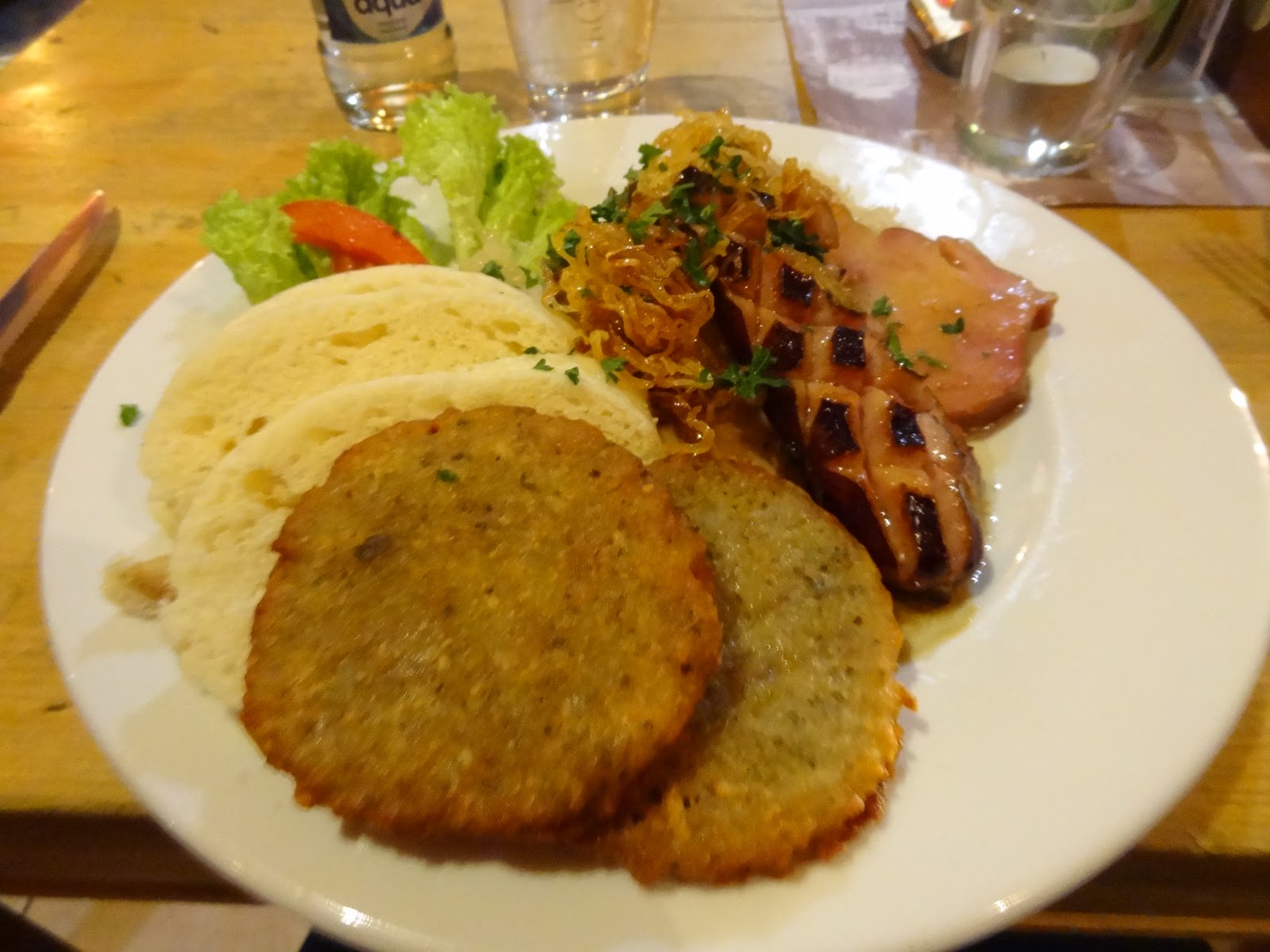
After around two hours, I headed back to the hostel and in the morning took a long bus ride to Prague. The bus arrived at sunset and I went to the hostel and then walked around old town for a while. I went to a recommended restaurant that I was told had good, reasonably priced Czech food. I tried to order the three dishes the receptionist had told me to try, but the restaurant didn't have any of them, and the waiter just said, "I will bring you something good. Do you like meat?"


It was very tasty and filling. So much so that I returned the next night with a friend I met up with from the Spanish class I'm taking. 

(Too many moon pictures? Prague)

     In the morning I walked around and then met up with my Spanish class friend and his friend. We went to Prague Castle, which dates back to the 9th century, although it has been largely modified and rebuilt along the way. It had great views of the city below, and a pretty good looking church. 

(A View From Prague Castle)
     
     Later, we went to the cafe frequented by the likes of Einstein and Kafka. It was as expected, surely devoid of any of its originality (in part due to its closure for almost 45 years), yet pleasant enough. I got a great hot chocolate with vanilla ice cream. 
     The rest of the day mostly consisted of walking around and eating dinner. The city was pretty but was unbelievably touristy because it was the end of the year and Prague is known as being one of the best places to celebrate New Year's Eve. I, however, would be flying back to Madrid to celebrate in the Time's Square of Spain, Puerta del Sol. But that is a story for another post. I had a very nice time on my holiday, despite Katie's not being able to accompany me. But no matter, she arrived New Year's day, and is here to stay! Stay tuned for my next post: The Saga of Katie and The Missing Visa.

(A Car On A Street In Prague)

Sunday, January 13, 2013

Vienna

     On Christmas Eve I flew to Vienna and thus began a week long vacation. Originally, Katie was supposed to go too, but she was stuck in the U.S. waiting on her Spanish visa (more on that later). I arrived in the evening and the next morning I went to the Belvedere museum and saw an amazing exhibit on Gustav Klimt, a unique early 20th century painter, whose famous works include Judith I and The Kiss. Some people think he's kitschy, but I like him a lot. For me, his art evokes a level of feeling that few other artists accomplish. He isn't one of those artists who I 'appreciate' but don't really care for; he is one whose art I look at to provoke feeling and inspiration.
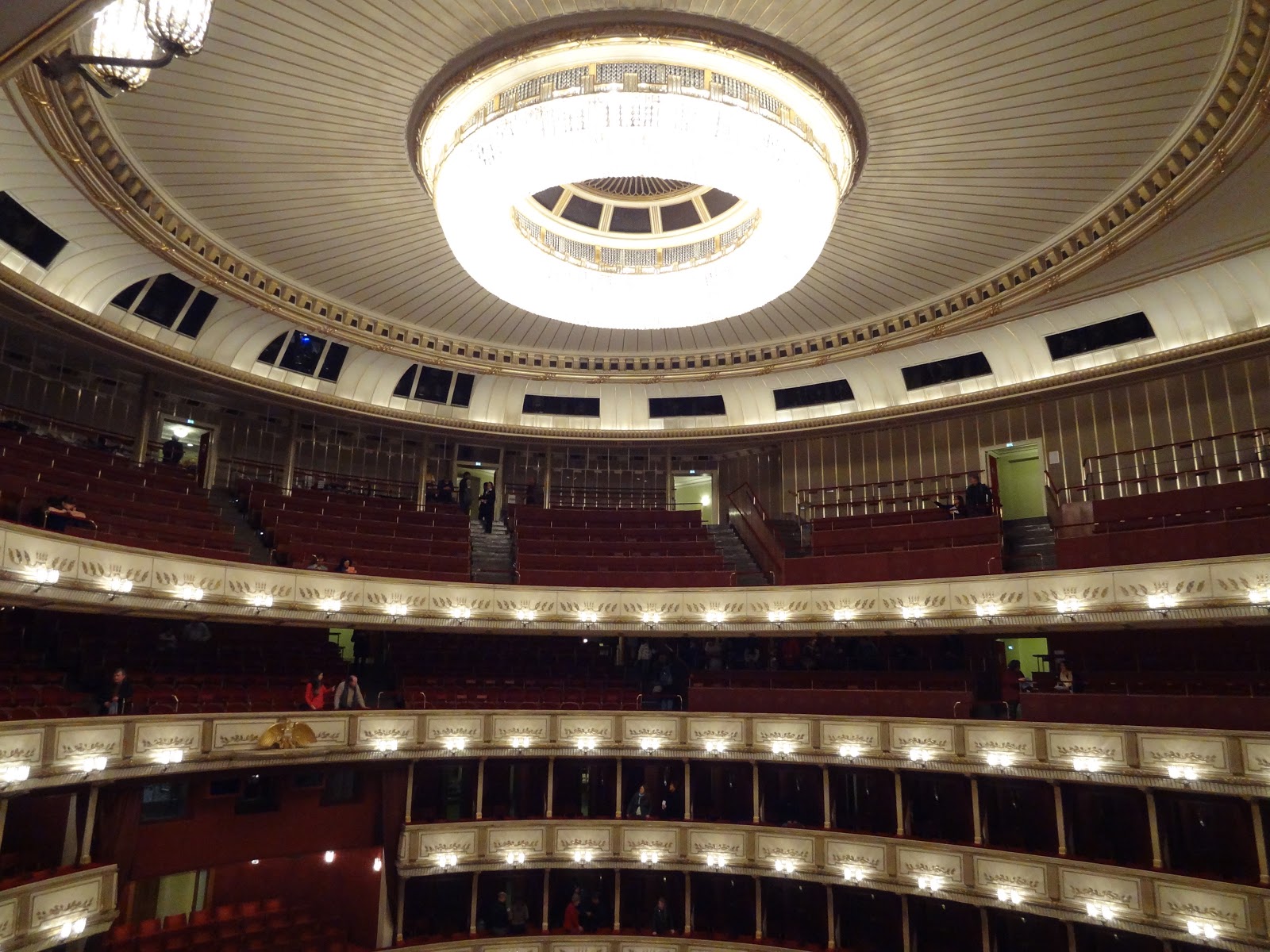
     That night I went to the famous Vienna State Opera house to see The Nutcracker. I have to admit, I have never enjoyed this ballet. But I had heard that you could buy cheap standing room tickets and that the performances were some of the best in the world. So I waited to buy a ticket, a grand total of 3 euro, and watched the ballet comfortably from the 4th deck.

(The State Opera house)

I was really impressed with the performance— dare I say I enjoyed it? Yes, I enjoyed The Nutcracker. I suppose until then I had only seen it put on by 12 year olds or on small television screens. Everything, from the orchestra, to the dancing, to the set changes, was impeccable.

     The next morning I went to Schönbrunn Palace, the Habsburg's summer home only a few kilometers from the city center. It was impressive in stature, to say the least. Built in the 17th century, it not only housed the Habsburgs but later, for a few years in the early 1800s, Napoleon lived there. At the gates, two pillars topped with golden eagles remain from his time there.

(The front of the palace)

(Inside the palace— the room where Kennedy and Khrushchev met in 1961)

(The back of the palace)

     Next, I went to Freud's house of 47 years. It has been turned into a museum, and is devoid of almost all original possessions, thanks to his having to flee Austria at the start of WWII. There is one room that still has some original furniture and things, but things are mostly left to one's imagination. 
     Later I went to St. Stephen's Cathedral, Vienna's most famous cathedral, located in the center of town. Begun in the 1100s and not finished for centuries, it represents different architectural periods, and inside are multi-colored lights that shine on the pillars and make for nice pictures. 

(Interior of St. Stephen's)

     Vienna is famous for its elaborate coffeehouses, and the most famous one is Café Central. It boasts a large list of famous historical clientele, including Freud and Leon Trotsky. 


I don't think a local has been in there in twenty years. The place is aesthetically pleasing, the food is okay, and the atmosphere is nonexistent. 


     In search of some real culture, I went back to the opera house to see Richard Strauss' opera, Ariadne auf Naxos. Thankfully, there were little screens in the standing room section that had English subtitles of the German operatic singing. Knowing what was being said and sung made the opera almost enjoyable. I really don't know how people listen to operas without knowing what is being sung. The singer can be singing the saddest sounding song, yet the words are hilarious or nonsensical [at least in this opera, where the plot had to do with putting on an opera (high art) and a comedic play (low art) simultaneously]. Anyways, not my cup of tea but I certainly can appreciate the talent it takes to sing opera. 

(The State Opera house)

The next morning I went to the Central Cemetery (not centrally located), an enormous cemetery which includes residents such as Beethoven, Brahms, the Strauss family, and famous atonal composer Arnold Schönberg. I think listening to their music is probably a better way to pay homage to them than visiting their graves, but you don't have the opportunity every day...


     Back in town, I went to the Secession building, home to the famous Vienna art movement of the same name, which began in 1897 and in which Klimt played a major role. The movement's credo, which is displayed on the building itself, is "To every age its art. To art, its freedom." 

(The Secession Building)

     Of the many art exhibitions that were held and are still held in the building, the one dedicated to Beethoven was the most famous. Held in 1902, it included a frieze painted by Klimt, which was intended to be only a temporary work of art but which was saved and is now on display in the museum today. According to the pamphlet I picked up, "The frieze takes its theme from Richard Wagner's interpretation of Beethoven's 9th Symphony and depicts humankind's search for happiness." It is a wonderful, diverse work of art and I was lucky enough to catch the exhibition which let observers climb stairs to be at eye level with the frieze, which is displayed high above the ground. The frieze covers four walls, but the most famous image is titled "The Kiss To The Whole World." 
     That evening I tackled the Kunsthistorisches Museum, an enormous museum, the main attraction being the picture gallery but also home to significant Egyptian, Greek, and Roman artifacts. The museum is famous for its collection of Bruegel paintings, the largest in the world. It has many of his famous paintings (such as The Tower of Babel and The Peasant Wedding), although I favor the few that the Prado has here in Madrid. One thing I liked about the museum is that there were several instances of artists painting side by side the paintings. 

(The Hunters in the Snow, Bruegel 1565)

Another nice touch was that all of the paintings had good descriptions below to explain the historical and artistic context of the paintings. It is enjoyable to learn history through paintings, and the aid of a few sentences helps one appreciate the more mundane royal portraits of queens, kings, dukes, duchesses, palaces, and such. Though as everyone knows, spending hours and hours looking at paintings and reading descriptions is tiring, and after a while one becomes somewhat desensitized. Museums like the Kunsthistorisches need repeated visits with fresh eyes to fully appreciate the enormity and significance of the collection. I did my best, however, and took a few needed breaks in the four or five hours I was there to sit on the nice couches they have in the large rooms. 
     Vienna was a nice city, although I found it quite expensive, with pitifully small student discounts to the popular attractions and a certain stale air of living in the past. I didn't get a good meal while I was there, but the Opera house and the art museums were definitely worthwhile. 
     Stay tuned for posts on Budapest and Prague coming soon. 


Monday, December 24, 2012

My First Semester As A "Profe"

     Well, the world didn't end but the semester sure did. On Thursday I finished my first semester as a(n) (assistant) teacher. I loved it. It's sort of cheating I guess, because I don't have the responsibilities of grading papers or disciplining students, but still, I teach classes. Being an assistant is great, because I only have each class once a week, so the students are always excited to see me.
     The kids are really great. They're also really talkative. You cannot get a class to be silent for more than ten seconds, ever, except one class I have of 12 year olds who are all very good students and love to learn. Well, 1 for 16, could be worse. But what the classes lack in discipline they make up for in amiability. I can't go five steps in the halls without five students saying hello to me.
     The last week of the semester was the best week. I prepared a Hanukkah lesson for all of my classes so that they could learn something new and not be bored with the same old Christmas lecture. It worked. Many of the students had never even heard of Hanukkah. I told them the story, some traditions, gave them a worksheet, and finally two Hanukkah songs. First, we listened to them ("Hanukkah O Hanukkah" and "I Have A Little Dreidel"), and then I brought out a guitar I had borrowed from the music room and we sang the Dreidel song. It was great, everybody was entertained and happy, and all week I would hear kids singing the refrain in the halls. After we sang the song, I played a little Blues tune on the guitar, which is what they really wanted me to do. I was greeted with loud applause, chants of "¡Tú sí que vales!" (which can be translated as "You are really worth it"), and requests for more. It was really great to see them all interested. Afterwards, I asked them to sing a traditional Spanish Christmas carol, of which there are many. They sound much more like Hanukkah songs than popular American carols.
     The week prior, I had gone to school on Friday (I don't work on Fridays) just to teach a couple of P.E. classes how to play baseball. I had done this once before, and since then all of the gym teachers have been asking me if I could come teach their classes. The kids really love it and I am happy to teach them. No one really plays baseball here in Spain. It's like rugby in the U.S. You don't find many people who know exactly how to play or have seen or played a game. So I suppose I'll continue next semester guest-teaching baseball when I can.
     It's only been a little over two months, but I've learned a lot about teaching. For one, it isn't easy. Trying to entertain 30 kids (or at least get them to listen) is pretty difficult. But I have realized that if just one person is wanting to learn, it's worth it. Also, I've learned the benefits of teaching the same lesson more than once. The first time is like a disaster compared to the third or fourth time. Hopefully, with practice, first lessons will be more honed. Thirdly, being a teacher means I learn every day, whether it be a teaching method, a way of explaining something, how to deal with a situation, something about Spanish culture, or even about British culture (the student books are Oxford). I really enjoy being in a learning environment.
     And then there are the other teachers. They are extremely nice and helpful. I have good relationships with all of the English teachers, as well as the music teacher, a couple of P.E. teachers, the cafeteria lady, and various people. Before I arrived I had heard of auxiliars last year being uncomfortable in the break room because of the economic crisis, but that has not been my experience at all. Everyone is very pleasant and it is a real pleasure to be at school.
     En fin, I had a great first semester (or technically, trimester), and I am looking forward to the new year. I know I will continue to learn and hopefully I will improve as a teacher, or as the kids call me, "profe."


Sunday, December 9, 2012

Spanish Language Fluency: A Work In Progress

     Last night I watched a Spanish film (Hable con ella, a film by Spain's famous director, Pedro Almodóvar). This was an event, because it was the first Spanish film I have watched without subtitles and understood the dialogue. This is to say nothing of the film— It was very weird, though I recommend it. The point is, I was able to follow, for two hours, the dialogue and plot of this film. I consider it an accomplishment, and something I could never have done before I arrived in Spain.
     I have been in Madrid now for two and a half months. In this time, my Spanish (listening comprehension, speaking, reading, writing) has improved greatly. One of the biggest factors is, of course, that I am surrounded by Spanish speakers every day. But without putting forth much effort, I could easily pass these months without improving much. Fortunately, I am trying to take full advantage of this opportunity in Madrid by learning as much Spanish as I can. I am doing this in several ways.
     First, I live in an apartment with Spanish speakers (a Spanish guy and a Brazilian guy— recently I moved from my old flat, but that is a story for another day). Secondly, I attend an "intercambio" every week, which is a language exchange, held at a bar, where people go to improve the language they're learning. I've been going to this intercambio since my first week here, and have made a few friends, who I meet there each week.
     Thirdly, I have a one-on-one intercambio with a guy in his mid-twenties from Madrid, for two hours twice a week. We walk around the city, he shows me places I haven't seen, and we split the time between speaking English and Spanish. Needless to say, between these intercambios, I am learning how to speak "real" Spanish.
     Fourthly, I speak Spanish at school with teachers as much as possible. I have even made friends with one of the P.E. teachers and have taught one of my classes (in Spanish) how to swing a baseball bat. More lessons are to come, and eventually we're going to play a game. Moreover, next week I'm going to start a third intercambio with one of the teachers, staying after school for an hour and a half or two hours once a week.

(The word notebook that is always in my pocket. Almost time for another one.)

     And since that is not enough, I have enrolled in an advanced Spanish course which meets for one hour, three times a week. Monday will be the beginning of my second week in the class, and the level is very high. There are around ten people in the class and I might be the worst at Spanish. The level is C1, which is the second highest level on the European Union scale of foreign language proficiency.
     I am taking the class for two reasons. The first is to improve my Spanish in general. The second is to prepare to take a Spanish exam at the end of May. A couple of weeks ago I started thinking about taking a test toward the end of my time here in Spain, in order to see how much my Spanish will have improved. I found the D.E.L.E (Diploma of Spanish as a Foreign Language), which is issued by the Instituto Cervantes, and is the only official test recognized by the government of Spain. It is equivalent to the English proficiency tests given by Cambridge. Tentatively, I am planning on taking the C1 level test, which is the second highest level test that the institute issues. This test is hard.

"The DELE C1 diploma proves that the student's progress with the language has been successful and that he or she has a higher than advanced level of Spanish. This diploma certifies the linguistic ability to understand and recognize implicit meaning in a wide variety of lengthy, difficult texts. It also certifies the ability to express oneself fluently and spontaneously without showing any signs of making any unnatural effort to find appropriate expressions, and to make flexible, effective use of Spanish within social, academic and professional contexts. Finally, the diploma certifies the ability to produce clear texts; correct in structure and detail, written about complex topics, and showing the correct use of organization mechanisms, articulation and cohesiveness." 

     Needless to say, if I were to take it now, I would certainly fail. But I have six months to improve my Spanish, and I am hopeful that I will be at or near this level by June. Even if I'm not, I think that having this concrete goal to strive for will push me to improve my Spanish more and faster than I would without a self-imposed challenge. The course that I have enrolled in will meet until the test date, which is great because it is an extended period of time, and the class is not solely focused on studying for the test, though we will to practice exams, but rather it is guided toward Spanish language improvement in general.
     Finally, I am trying to read as much in Spanish as I can, including newspaper articles, poetry, plays, and (maybe) books. Currently, I am reading Lorca's drama, Bodas de sangre (Blood Wedding). I don't think it's going to end well for the characters.
     And as for writing— the main source of improvement is through email, though Facebook helps too. I've been sending more emails in Spanish than I thought I would, and not just one-liners. When I attended the Leonard Cohen concert back in October, I sat next to a woman who struck up a conversation with me. A mid-fifties madrileña, we talked before the show and during the intermission, and I got a bite to eat with her and her friend after the show. We've been exchanging emails once a week or so since then (she writes long emails, not just quotidian in subject matter, but discussing literature, philosophy, and writing). So naturally I have to reply in paragraph form, which is good but also means her emails stay in my inbox un-replied to for a little longer than usual. We finally met up again this week to attend a classical cello concert and it was great.
     All in all, I am really enjoying my time in Madrid, and I don't have much 'learning withdrawal' from college because I am learning every day.