Saturday, March 1, 2014

Edinburgh

     
     So, I'm behind on blog posts. I'll try to change that this month. I've been busy with several things that I'll talk about in future entries. In any case, Katie and I were in Edinburgh over Christmas break, and it's a lovely city. It's very walkable and has distinct architecture. We got the best views from Arthur's Seat, a dormant volcano inside the city limits. It's a pretty short walk up the side of it and from the summit you can see the whole town and the Firth of Forth, which flows into the North Sea. 

View from Arthur's Seat


     We walked around quite a bit, went to coffee houses, used book shops and clothing stores, and of course museums. I tried the traditional dish haggis, which is mainly composed of sheep organs. It was tasty. We also had some excellent Indian food at the city's oldest Indian restaurant. 

The haggis is next to the tomato
     We went to the National Museum of Scotland, which among other things had some of the Lewis Chessmen, chess pieces discovered in the 1800s on the Isle of Lewis in Scotland and carved out of walrus ivory. They date to the 12th century. The rest of the pieces are in the British Museum in London, which I had seen the week prior. You also get great views of the city on top of the museum. 

Inside the National Museum of Scotland
     One night we went to an historic movie theatre and saw "All is Lost," the film starring Robert Redford that came out in 2013. I enjoyed the movie and Katie did as well, though she is always weary of would-be philosophical movies—she often thinks they try to muddy the waters to make them appear deep. In any case it was a nice experience to see a movie in a city to which we hadn't been. 
     We spent three days in Edinburgh and left on New Year's Eve to head back to Jack's parents and then on to London that evening. It was definitely worth the trip up. Edinburgh is unique and has a certain charm to it. And you don't feel rushed around trying to do a million things. It's a city you can visit without much of a schedule and just see what you discover. 

Tuesday, January 28, 2014

Melton Mowbray, England

     My friend Jack, with whom I worked and played concerts last year, invited Katie and me to his family's house for Christmas in Melton Mowbray, England. We accepted. It proved to be a wonderful time. Katie and I were in Britain for two weeks and visited London, Melton Mowbray, Edinburgh and Brighton. This post is just about staying with Jack's family—more posts will come soon.
     We arrived at Jack's family's house on December 23rd and stayed for five days. Melton Mowbray is less than two hours north of London, located in the region known as the East Midlands. Melton is famous for being the origin of pork pies, and I was also told it was where the phrase "paint the town red" originated. Melton used to be a big hunting town, and the packs of fox hunters would arrive in their red coats and eventually get a bit out of control at night around the town.
     Jack's family couldn't have been nicer and his dad is a wonderful cook. We had typical British food like steak & kidney pie on Christmas Eve and turkey for Christmas dinner, as well as non-conventional English foods like lamb with rosemary and pasta carbonara. The desserts were incredible. If I hadn't been so busy stuffing my face, I would've taken more pictures.


     On Christmas Day Jack and his family gave Katie and me generous gifts, including books, notebooks, socks for Katie, chocolate for me, and more. Katie gave the family a traditional painted wooden Ukranian jar and I gave them typical Spanish foods. We were overwhelmed by their munificence.

Borrough Hill
     After lunch we drove a few minutes down the road and took a walk at Burrough Hill, the site of an Iron Age fort. It was a clear day, though the wind was cold. Overall it was an excellent Christmas day walk. 
     For Christmas dinner we feasted on a 20 pound turkey, tons of other sides and delicious desserts, including chocolate cake and treacle pudding. We also opened a traditional Christmas item called a cracker, which contains a small drink and a crown. The name comes from the popping sound made as you open it by holding the wrapper at either end and pulling hard. 

Jack, Katie and I after Christmas dinner
     Another day we went to a quaint town with thatched houses for an afternoon walk. The weather turned from sunny to rainy as we were walking, but the countryside was beautiful and the air was clean.


On our walk


Same walk, 15 minutes later—it was pouring rain.
     The time we spent at Jack's was relaxing, joyful, and full of fantastic food. Katie and I loved every minute of the English hospitality. After five days we decided to go to Edinburgh for three days before spending New Year's in London with Jack. Next post coming soon!

Thursday, December 26, 2013

Hiking in El Escorial

     Early December and the weather was great for hiking, so Emir, Camille and I took a train out to El Escorial to walk some trails. El Escorial is famous for the enormous monastery Philip II had constructed during the later half od the 16th century. It's only 45 kms from Madrid but I hadn't been out there yet, and still didn't get into the monastery. Instead, we walked past it and into the hills for some nice views. 

Part of El Escorial 
     When the monastery was being constructed, Philip II would walk into the hills and sit on a seat he had ordered to be carved out of rock so he could watch it being built. You can easily hike up to it and sit there yourself, which we did. 

The seat across from Philip II's, with El Escorial in the background
     We continued to hike up into the hills and the sun made the day nice enough to go shirtless and be very comfortable. At one point I was certain I was being burned, although fortunately I narrowly escaped it. It would be a bit embarrassing to get a sunburn in December.
   
Emir on a rock

     Later on we found some fresh oregano and after a nice lunch of chorizo and tomato sandwiches we got lost, as usual. We tried to take a different way back down but lost the path and decided the sun was getting a bit low in the sky to keep going on so we had to double back. As soon as the sun went down the temperature dropped about 20 degrees and soon we had our winter coats and scarves on again. All in all it was a nice daytrip hike. From the hills we could see the cloud of pollution settled over Madrid and it made us glad we had escaped for the day to get some fresh air.
In King Philip II's chair

Monday, December 16, 2013

Flamenco en el Ateneo

     Last weekend I attended a packed flamenco concert at the historical Ateneo in Madrid, a long-time cultural institution. The venue is attractive, with vaulted ceilings and gold leafed images on the wall. The show was divided into two parts. First to perform were singer Eva Romo from Granada and guitarist José María Ortiz from Jaén. Eva had a beautiful voice. They played a farrucatientos tangoscolombiana and bulerías, but the most powerful song was a granaína y media granaína, which is a flamenco form originally from Granada. During this song it felt as if her voice "moved through the notes without breaking them," as Lorca described legendary singer Silverio Franconeti in Poema del cante jondo. My chest tightened, and for the first time I realized how powerful a flamenco song can be. There was something about her pure voice quivering between notes that made my eyes wet.

Eva Romo and José María Ortiz
     After their performance, Madrileño flamenco singer Jesús Chozas entered the stage and sang a moving tonás, one of the oldest and purest flamenco forms. After, Pablo San Nicasio joined him and they played a carcelero and folía. Chozas has an incredible voice—booming, crisp, gravelly yet sweet. He is one of the most enjoyable flamenco singers I have heard. Pablo's guitar work was restrained and precise, an elegant display of accompaniment that showed his deep knowledge of the art.   

José Chozas and Pablo San Nicasio
Guitarist Alberto Espejo joined Pablo for a beautiful instrumenal and then all three played a garrotín, a flamenco form that originated in Asturias (a northern province in Spain) and was "flamenco-ized" like many other forms have been over the years. They finished with a fantastic rendition of a popular Spanish bolero from the 1940s, "Piensa en mí," which was revitalized a couple of years ago by the singer Luz Casal. Chozas' version is rousing and powerful, a perfect closing song. 

     The audience was left in ecstasies and demanded an encore from all five performers. They delivered, all three guitarists accompanying Eva and Jesús, who took turns singing verses.

From left to right: Alberto Espejo, Jesús Chozas, Eva Romo, José María Ortiz, Pablo San Nicasio
     The concert was an overwhelming success, and deepened my growing relationship with flamenco. When played well, it is an art that can produce strong feeling in both performer and listener. I look forward to following the careers of these artists dedicated to the art of flamenco. 

Saturday, November 30, 2013

Ukraine

     Recently I went to Ukraine for the first time, to see Katie. She is teaching at a university in Cherkasy as a Fulbright Scholar. I flew into Kiev and the next night we went to Cherkasy, which is three hours by bus from Kiev and located on the Dnieper river.
     But first thing's first. We got some Ukrainian borsch (a beet-based soup) at a place in Kiev called The Black Pig. It was delicious. We also ate great Ukranian dumplings, called vereniki.


     Then we visited St. Mikhailovsky monastery. We didn't get to St. Sophia this time, because it was closed the day we were there. But next time we will certainly go. 


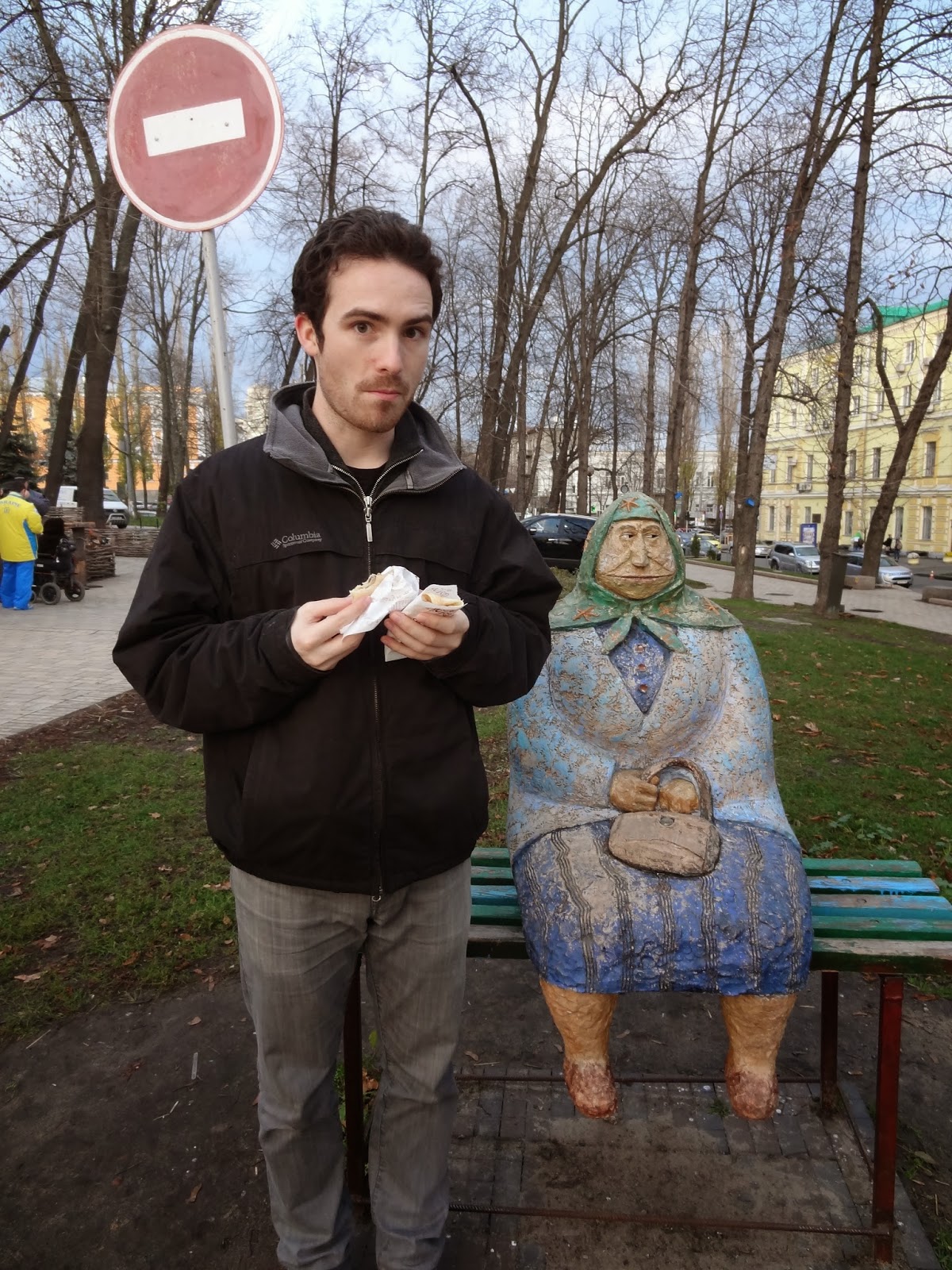
     We walked around the city and stopped at a place to get blini. Blini are very thin pancakes made from buckwheat flour. They are very similar to crepes and even tastier. I got one filled with mushrooms and one with apricot jam. 

Eating my blini with an elderly Ukranian lady
     After going to the Fulbright office to listen to Katie's friends give a presentation, we took the bus to Cherkasy. Katie lives with a married Russian couple who don't speak English, so it's very good practice for her. Also, her room is enormous. Another plus is that the mom makes great food! I had several servings of her borsch. I really hope Katie learns how to prepare it.


     We visited the university where Katie teaches and I sat in on a couple of her classes. She mainly teaches fourth year students, and their English is excellent. Katie cooked some buckwheat with mushrooms and chicken for dinner and I decided I really liked buckwheat—so wholesome, so diverse.
     On Saturday we went to the market, which sells clothes, food, plants, etc. It's huge and pretty cheap. We bought some fruit and spices. 


     This was not a touristy trip. It was very relaxing, we ate good food and I got to see where Katie lives and works. It's a fantastic experience for her and she is a really good teacher. There are barely any native English speakers in Cherkasy, and not very many expats, which makes communication frustrating at times. But I think in the end it is very enjoyable and beneficial—and who wants to be comfortable all the time anyway? One of the best ascpects about living abroad is the distinct absence of complacency, replaced by the constant need to improve and learn how to adapt to a different culture and succeed in a foreign country.

Saturday, November 16, 2013

"Flamenco Hoy" Award Ceremony


     Wednesday night I was in a room with over a hundred flamenco artists and aficionados at the 'Flamenco Today' award ceremony. Many of the best and most important contemporary flamenco artists were present to receive awards given by the Crítica Nacional de Flamenco, a group of influential members of the flamenco community. It is an invitation only event and my friend and I were definitely the only non-Spaniards to attend. So, why did I get to go? Long story short, I know a girl who knows a guy who I now know. Long story a little longer, I am looking for a flamenco guitar and one of my friends knows a respected flamenco guitarist. The guitarist invited the girl I know to the event, but she couldn't go and sent me the invitation. I talked with the guitarist and he said he would be happy if I attended. The flamenco guitarist, Pablo San Nicasio Ramos, happens to be on the committee who elects the winners of the awards.


     The event was supposed to start at 9pm. We showed up at 9:15 thinking we might be late. I must've forgotten what country I was in. The presenters took the stage at 10:45. In the interim, we were served drinks and several tapas, and the room filled up. We got good seats at a table near the stage, which we shared with José Anillo and company, who won an award for best singer. 
José Anillo
     The presenters would give a few awards and then the 'house band' would come on stage and play a couple of songs. The room being filled with flamenco artists, I thought the audience would  listen closely and shout timely olés. Not exactly so. They talked amongst themselves, probably wanting to enjoy the rare occurance of so many artists together in one room.


    The winner of the best solo guitar album was Juan Manuel Cañizares, which was special for me because he started my still-growing obsession with flamenco music. He was there to accept the award.

Juan Manuel Cañizares
     Another winner was La Argentina, who I am looking forward to seeing at the Auditorio Nacional this year.

La Argentina
     After the show I met Pablo for the first time, who could not have been nicer. He is a well-respected music journalist as well as flamenco guitarist and has been generous in imparting to me some of his vast knowledge of all things flamenco. I even went to his house last week to try out a guitar he had, where I received my first flamenco ¡olé! 
     Needless to say, the award show was a success and I look forward to continuing my flamenco education this year.

The winners (All of the night's winners can be found HERE. )

Sunday, November 3, 2013

Sigüenza, Pelegrina, and La Ruta de Don Quijote

     After a month and a half in Madrid, it was time for some fresh air. So Emir, Camille, and I took the train to Sigüenza, a small town 130km north in Castilla-La Mancha. The priest in Cervantes' Don Quijote was from there, and it has the typical cathedral growing out of the city's center, and the typical castle rising high above. We went there as a starting point for some hiking. As I mentioned previously, I've started a 20th century Spanish poetry discussion group, and the previous week we read two poems titled Castilla, by Ramón Machado and Miguel de Unamuno. It piqued our appetite to get out of the city and see the "Tierra nervuda, enjuta, despejada..." (Sinewy, dry, spacious land). So we picked a couple poems from Antonio Machado's book Campos de Castilla and next thing we knew we were hiking in the Fields of Castilla


     The plan we decided on was to hike from Sigüenza to a very small town called Pelegrina, about 10km away. The way there happened to be part of the ruta de Don Quijote, and took us through Castilla's arid land. 


     After losing the trail for a while (appropriate for the Machado poem we were reading about there not being a trail to begin with), we came across a shepard who directed us in the right direction. We walked to the ridge to which he pointed and saw Pelegrina in the distance. 

Pelegrina in the distance
Pelegrina from the campos de Castilla
     There are 19 inhabitants in Pelegrina. At the top of the village there is a XII century castle in ruins that met its demise during the war with Napolean toward the beginning of the 19th century.

Flowers on the way to the castle
The ruins of Pelegrina's castle

     The best part of seeing the castle was probably the ascent, because there was a fig tree with low hanging fruit. It was just one of the edible wild fruits we snacked on during our hike. The others included blackberries, Italian plums, and rose hip. 


     From the town we descended into the ravine, yellow with poplars lining the river. 

The ravine
     The sun was setting as we hiked out of the ravine and looked for a place to sleep for the night. There were goats, feasting on berries. 

Dining goats
     We had lentils, rice, muffins, and delicious figs for dinner. The night passed well, though very cold. It was worth it to see the stars. The next morning we packed up and headed back to Sigüenza to catch the train. 

View of Pelegrina from the ravine
Outside Sigüenza
     The hike was a success, as was the poetry discussion, which lasted more or less the entire trip because of our proximity to the subject matter of the poems. Below is Antonio Machado's poem about "el camino." In Spanish, the word for "walker" caminante and the path he follows is the camino. The direct relation of these words is much more evident in Spanish than in English, which makes for a lackluster translation. But now that you know the meaning of caminante and camino, I will give you a half-translation of the last two lines.

"Caminante, there is no camino,
but wakes on the sea."

     Caminante, son tus huellas
el camino, y nada más;
caminante, no hay camino,
se hace camino al andar.
Al andar se hace camino,
y al volver la vista atrás
se ve la senda que nunca
se ha de volver a pisar.
Caminante, no hay camino,
sino estelas en la mar.