Wednesday, June 26, 2013

Flamenco Fluency: A Slow Work In Progress

     Since I saw Cañizares, El Cigala, and Tomatito last Fall, I have made a lot of progress in my self-education of flamenco music. For starters, I have read Don E. Pohren's trilogy of books on flamenco, which I would highly recommend to anyone interested in this art form. Originally, I wanted to read the first book, The Art of Flamenco, before I came to Spain, but since the cheapest copy on Amazon was over $100, I decided to wait. Then I found this amazing music library here, the Conde Duque library, that is a dream come true. Among everything else, it had all three of the flamencologist's books, in English, for my reading pleasure. This single event revived my pre-departure goal of learning flamenco guitar, which had faltered in the beginning months. The library also happens to have hundreds of flamenco CDs, which I continue to take advantage of, and dozens of flamenco guitar books, which are incredible. And if that weren't enough, the library has music practice rooms, for free, Monday-Friday from 9am to 9pm. All in all, it is a winning combination.
     Needless to say, since this wonderful discovery, I have immersed myself in flamenco music, starting with, and consisting largely of, what Pohren might call pure flamenco music. Pohren was extremely knowledgeable about flamenco music and also extremely traditional in what he considered to be real flamenco music. It is fun to read his rants on the bastardization of flamenco, something he compares with blues and its offspring, rock and roll. Flamenco is a somewhat natural progression for me, because it has many things in common with blues music, which I have loved and played for years. Both genres come from the gut, and deal with the accursed and eternal questions. Though both have a very serious side (in flamenco these songs comprise what is called cante jondo, or deep song, where the lyrics deal largely with death), they also take on lighter subjects. In other words, neither blues nor flamenco is just for listening to when one is depressed—there is much joy in both genres.
     Unlike my discovery of blues music, which worked backward from Zeppelin, I have begun my flamenco education largely from the beginning of its recorded history. Many of the CDs I have been digesting consist of recordings from the 20s and 30s, and are of both legendary singers (such as Manuel Torres and Manolo Caracol) and guitarists (like Ramon Montoya, Niño Ricardo, and Sabicas). My appreciation of flamenco singing has grown a lot, and I enjoy it now, except for early in the morning. Understanding the words they are singing is much more difficult for two reasons: 1) because the singers are almost all from Andalucía, and therefore cut off the ends of words that end in consonants and blend the beginnings and ends of words into each other, and 2) because they can draw out and distort one word over many musical bars. However, I am learning and improving, and when I saw José Mercé perform a couple of weeks ago I even had the success of identifying one song by its opening line.

(Manuel Torres singing "Siempre por los rincones")

     My appreciation for and awe of the flamenco guitar continues to grow. I now think that flamenco guitarists are arguably the most talented guitarists in the world. If you are reading this and have an opinion of who the most talented guitarist in the world is, take a second and listen to Paco de Lucía. He is the master of flamenco guitar and began his illustrious career in the 1960s. He was also the right hand man of the most famous modern flamenco singer, Camarón de la Isla.

[Paco de Lucía performing La Barrosa (Alegrías)]

     I thought Spanish language fluency was difficult and slow going. Then I started to try my hand at flamenco guitar. As incredibly difficult as this art form is to learn, it is not impossible, as I am slowly discovering. Keith Richards once commented that when he first listened to a 1930s recording of legendary blues guitarist Robert Johnson, he thought there were two people playing guitar. It was actually just Johnson, doing everything at the same time. It is safe to say that if Richards heard any flamenco guitarist from the 30s, he would think there were four guitarists. Seriously, this music is ridiculous.
     There are specific techniques that flamenco guitarists use, and there are many flamenco song forms they must know as well, which have their own rhythms, meters, scales, chords, etc. Fortunately, the different song forms (such as Siguiriyas, Soleares, Bulerías, Tarantas) all sound distinct once you know what to listen for, and once you know how to play one Siguiriyas, you know the basic structure for all Siguiriyas. What I'm saying is, the form is very rigid, and thus learning flamenco guitar can be done systematically. I have started by learning the guitar techniques which are utilized specifically in flamenco music, which number less than ten, and which I am still either improving with or struggling to learn. This is sometimes frustrating, because I have been playing guitar for over a decade and I am used to picking things up rather quickly. Despite the frustration, I continue to make progress, and have not played so much guitar in several years.
     Originally I began to dabble with flamenco guitar to see how it would affect my songwriting. This reason is still foremost, although I now feel the urge to actually learn different flamenco forms and to be able to play them somewhat properly. It is a goal that will hopefully be realized next year, as I plan on tackling one song form every one to two months, keeping in mind that it will certainly become easier as I progress. For now, I am focusing on the essential techniques I must master to learn the various song forms. And so I continue my slow, slow acquisition of necessary skills to become competent in this highly skilled yet (and these don't often go together) visceral art form. And maybe one day, I will be able to do something like this:

(Sabicas performing a Bulerías)

Sunday, June 23, 2013

San José, Almería

     Two weeks ago I turned 23. I am not big on birthday celebrations, so there were no parties or anything, but instead Katie and I went to the beach. After some research, I decided we should try going to San José, a small town on the southeast coast, because it boasts many unspoiled beaches. We took the slow train from Madrid to Almería, which took six and a half hours. The scenery alone was worth the price of the ticket. We rolled through the bare plains of Castilla la Mancha, the region Cervantes chose for Don Quixote to experience his adventures, old windmills still standing and giant new ones spinning. Then came northern Andalucía as the terrain became mountainous, with more olive trees than I could count in a lifetime, through Jaén and then to Guadix, where from the train you can still see old cave dwellings that people lived in even last century. The landscape changed and we began to recognize the type of scenery in westerns and other films because, well, films such as Lawrence of Arabia, Conan the Barbarian, The Good, the Bad, and the Ugly, and Indiana Jones and the Last Crusade were all partly filmed in the province of Almería. The landscape is sparse and rocky, and the green of endless olive groves is replaced with a dark desert brown spotted with small bushes. All of a sudden the Mediterranean appears, its flatness and deep blue a stark contrast to the brown hills rising above it and the white city of Almería nestled in between. 
     It was past nine at night when we got off the train and walked to our hostel, ate, and walked around a bit. In the morning we took the hour bus ride to San José, walked to the albergue (a type of hostel) and reserved a room (online bookings are not possible and it is not on the hostel websites), and then headed for the beach. 

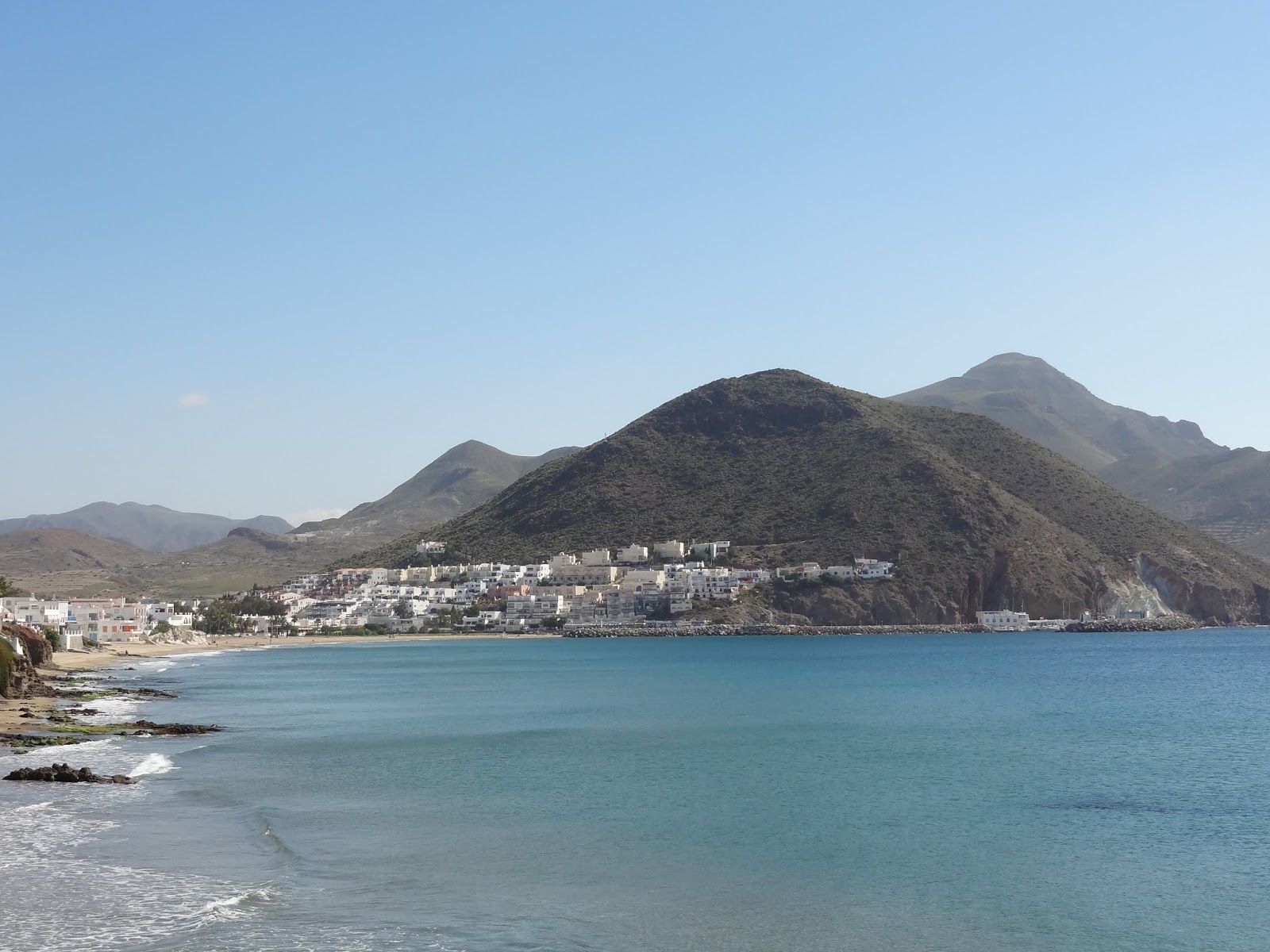
(San José beach)

     The first day we went to the beach seen above. It is San José beach and was only five minutes from our albergue. The beach was great, and the water was cold. We stayed on the beach for several hours and found a nice bakery at which we ate fresh Spanish tortilla sandwiches. 
     The next day we left early to walk to one of the famous beaches named Los Genoveses. It is so named because in 1147 a fleet of Genovese ships camped out in the bay for a couple of months, helping Alfonso VII conquer Almería from the Muslims. 

(Bay of Los Genoveses beach)
     It was particularly windy on the beach that day, so we walked the length of the beach and up to the cliffs to try to find a beach sheltered from the wind. 

(Katie on Cala Grande beach)     

     We found one, deserted, on the other side of the cliffs. It is, like most beaches in the area, a virgin beach, untouched by restaurants, bathrooms, lifeguards, and only accessible by foot. I believe this beach is called Cala Grande, which means Big Cove. 

(Cala Grande)

(Cala Grande)

     It was very calming to be able to see nothing but the cliffs, rocks, and sea, with no sound of civilization. We returned to the beach the next day after trying out others. 


     The walk to these beaches is a sight in itself. The surrounding land is desert, and has many desert plants. Katie's favorite vegetation was a tree-like plant she referred to as Dr. Seuss trees. These plants are called Agave americana. The tall stocks flower from the middle of the plant and can grow up to 20 feet tall. Curiously, the plants only flower once, at the end of their lives. 

(Agave americana—the plants with stalks have died, and the green ones have no stalks yet)

(Opuntia ficus-indica cacti were also prevalent) 

     The albergue we stayed at had a nice patio with a kitchen that opened every morning and evening. The food was a bargain and was always made from scratch. Our last night, we tried stuffed eggplant. This dish was amazing. Boiled eggplant, hollowed out, stuffed with meat, vegetables, and the scooped eggplant in a tomato sauce. I talked with the cook at length and got a recipe, which I have since cooked with success and will be cooking again tonight. 


     We had a wonderful time in San José. It was very relaxing and very beautiful, a good way to begin my 24th year. 

Monday, June 17, 2013

Patones de Arriba

     After being a bit disappointed by the village of Buitrago, I decided to take another chance at a small village in the region of Madrid. This time I chose Patones de Arriba, which is nestled into the foothills of the Guadarrama mountain range, and is known as a pueblo negro, or black village. There are several pueblos negros around Madrid, so-called because of the slate roofing that dominates the architecture of the towns. A couple of months ago, Jack and I bought tents with the intent of going camping in idyllic settings around Spain. The warm weather was late in coming, and the first time we got the chance to use them was in Patones de Arriba.

(View of Patones de Arriba from the surrounding hills)

     There are no official campgrounds around the town, but it is in a rural area, so we thought it would be easy enough to hike into the countryside and pitch our tents for a night. Camping in a non-designated campground is illegal in most of Spain, but there is something called 'overnighting' (pernoctando) that is legal, in which you pitch your tent in a spot for one night, and leave the next morning. 
     After a nearly two hour bus ride, we were dropped off in Patones and had to walk up into the hills to get to isolated Patones de Arriba. It was Friday and the village was practically deserted (it was in fact abandoned in the 1960s and has since been repopulated). We decided to get some lunch, and after seeing the high prices at most of the restaurants (the village has less than 200 inhabitants, but it is a somewhat popular weekend day trip for madrileños), we settled on a place called the Taberna Real, the Royal Tavern. 


It was a great choice—it is family owned, and the food is both delicious and a bargain. We had homemade everything, including juicy fried mushrooms, Spanish tortilla, ham croquetas, chicken alioli, and nata, a pudding dessert. 
     When we were finished, it was time to hit the hills in search of a nice place to camp for the night. 

(Katie on the trail)

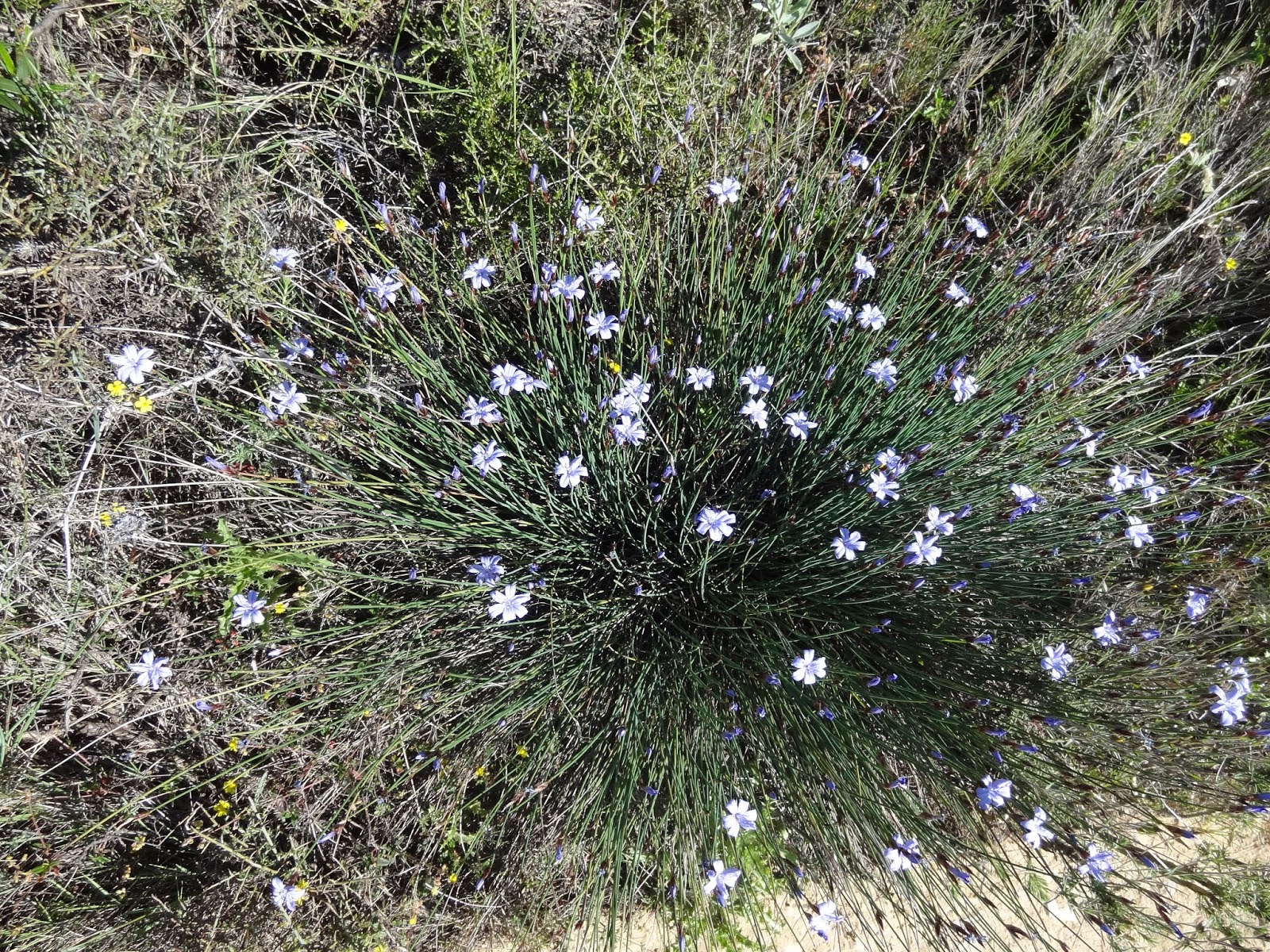
     The weather was great and, though there were few trees, there were many types of interesting flowers.


     After several hours of hiking, we set up camp on the top of a hill, one of the only flat spots we'd seen since leaving the village. From the hill we could see Madrid lighting up against the twilight and one of the biggest moons I've seen coming up over the trees. 

(Overnighting) 

     We had hauled a guitar all the way there and played music after dinner and took turns reading lyrics out of Alan Lomax's American Ballads & Folk Songs by the light of the moon. 

     The next morning we woke up, ate breakfast, packed up and started back toward the town, some three hours away. We (more specifically, I) decided to take a different way home, down a steep hill. It wasn't my best idea. Jack slipped on some slate and cut his arm, which we wrapped with part of a sheet, and then decided to just backtrack and return the way we had come. 


     We could've caught the one o'clock bus back to Madrid, but we had enjoyed the Taberna Real so much that we decided to eat there again and stick around until the next bus arrived at seven thirty. We played guitar, read, and just lounged around the rest of the day, content with our first camping excursion in Spain. 

Friday, June 14, 2013

Granada and Los Cahorros

     One of the English teachers at my school is from Granada, and she told me about the Cruces de Mayo festival that occurs at the beginning of May. She recommended I go, and even said we could stay with her niece. Upon finding very cheap bus tickets there, Katie, Jack, Emir and I decided to go.
     The festival consists of building big crucifixes out of flowers, which are then placed throughout the city. There are other activities as well, such as music and traditional dance performances.


     The crosses were colorful, but the main attraction was the city itself. Long a melting pot for Christians, Jews, and Muslims, Granada has some of the best Moorish architecture in Spain. The old part of town is built on a hill known as the Albaicín, which consists of many narrow streets ascending to a point where one has incredible views of the famous Alhambra palace. Toward the bottom, there are some well preserved Arab baths that display beautifully carved geometric shapes in the ceiling. 

(Ceiling of an Arab bath) 

(Inside the Arab bath)

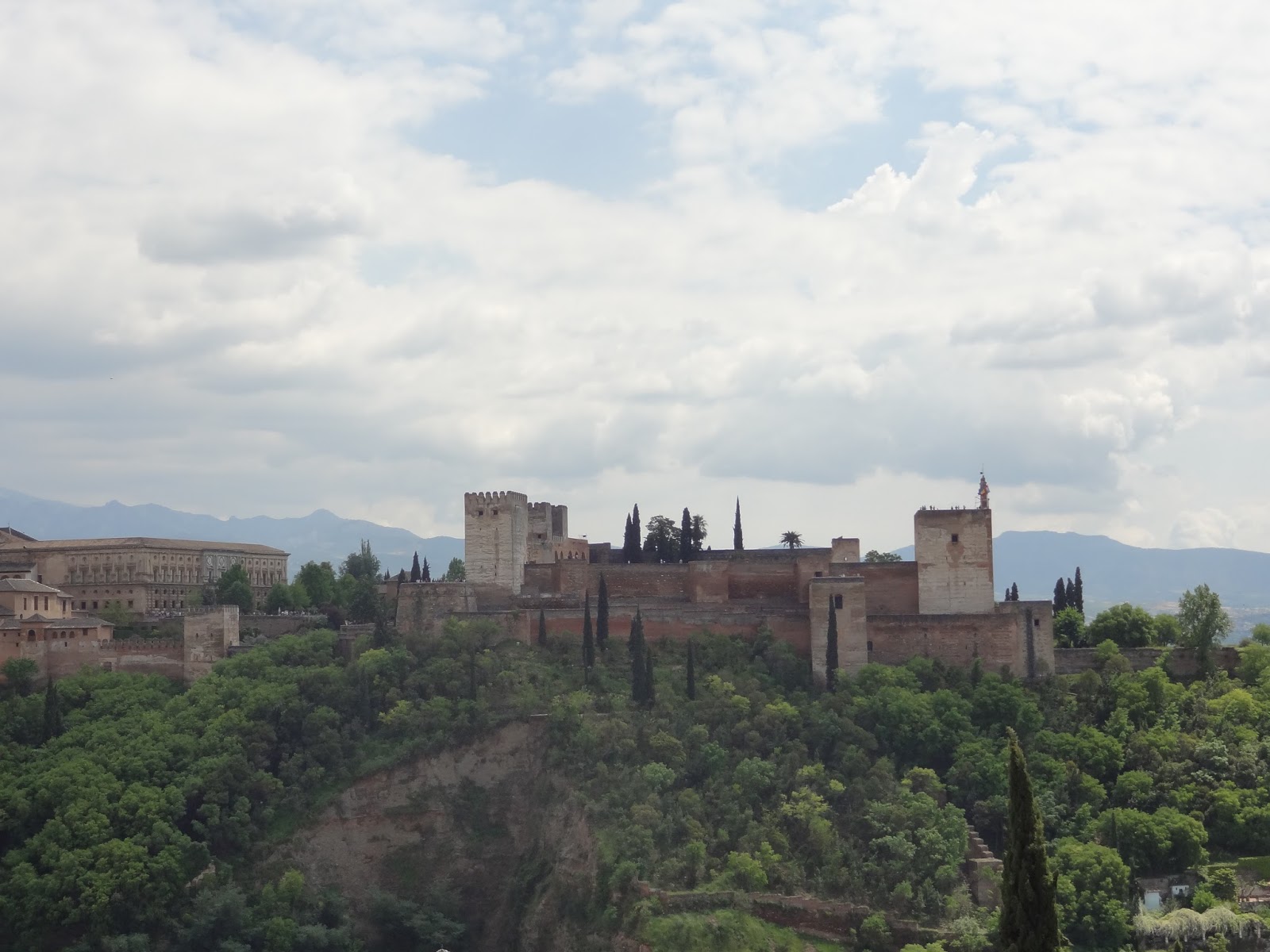
     Once at the top of the hill, the mirador de San Nicolás has the best view of the Alhambra and the Sierra Nevada behind. We didn't go into the palace this time around, because Katie and I visited on our trip to Spain three years ago, and the admission is a bit steep.

(The Alhambra)

     We were, however, treated at the mirador by a few gypsies playing flamenco outside of a bar. It was nice to see flamenco in a setting other than a concert hall, and they were good. 

(Flamencos)

 (Emir, Jack, Me, Lydia)

     Lydia later took us to one of her favorite tapas places, where you order a drink and get a free sandwich or various other generously portioned dishes. It was awesome, and the food was very tasty. 

 (Free with any drink)

     The next morning, we went hiking on a route suggested by the English teacher. It is called Los Cahorros and is only twenty minutes by bus from Granada. The place is beautiful and the trail leads you over a hanging bridge and along the Monachil river.


(Hanging bridge)

     We hiked for a few hours and had lunch by the river. I am always amazed by Spain's diversity, both cultural and geographical. Spain is only 1.2 times bigger than California but I'm convinced you couldn't see it all in a lifetime. 

Sunday, June 2, 2013

Buitrago del Lozoya

     Jack's girlfriend was in town a few weeks ago and we decided to take a day trip to a small village. We decided on Buitrago del Lozoya because it appeared on several "top day trips from Madrid" lists. Don't always trust these lists. We arrived after an hour and a half bus ride and walked over to the Picasso "museum," which consisted mostly of a couple dozen hastily drawn sketches made for and collected by Eugenio Arias, one of Picasso's friends. The town is very small, and the main point of interest is the old town, which has maintained its walls since the Middle Ages. This part of town is very small and very quiet. It is home to a small castle and a church, but the rest of the buildings are mostly from the 20th century and are very uninteresting. We quickly realized that the best part of the visit would be seeing the village from above due to its riverside location. With this in mind, we walked outside of the town to try to find a way to a higher elevation.

(Jack and Unity)

     We eventually found a path that led us up the side of a large hill, and at the top we had great views of the village below.

(Katie, Rocks)

(Buitrago del Lozoya)

     For better or for worse, the hike up the hill and the ensuing views were the highlight of the day. The town, like many formerly successful and important places, has lost all of its luster. I think a contributing factor to this is that the town is now located just off of a highway, and so is not properly isolated. This, combined with the fact that the antiquity is overshadowed by unimpressive 20th century housing, makes me wonder why the town is on so many "top day trips from Madrid" lists. Nevertheless, we managed to have a good time and enjoyed the calmness and clean air. And really, there isn't much to complain about, all things considered. 

Sunday, May 26, 2013

Mom's Visit, Part 2: Madrid/Segovia/La Granja

     Back in Madrid after a great weekend in Extremadura, Katie and I began to show my mom our favorite things to do here, as well as things we had rarely or never done. I took Mom to Casa de Campo, an enormous park in Madrid. We had the good fortune of beautiful weather all week, and the wildflowers were in bloom.

(Casa de Campo)

     One evening we stopped by Plaza Mayor, the famous plaza near the center of the city, and then walked past the Royal Palace nearby.

(Plaza Mayor)

(Detail of the Royal Palace, Visigoth kings flanking the arms of Spain. Moon.)

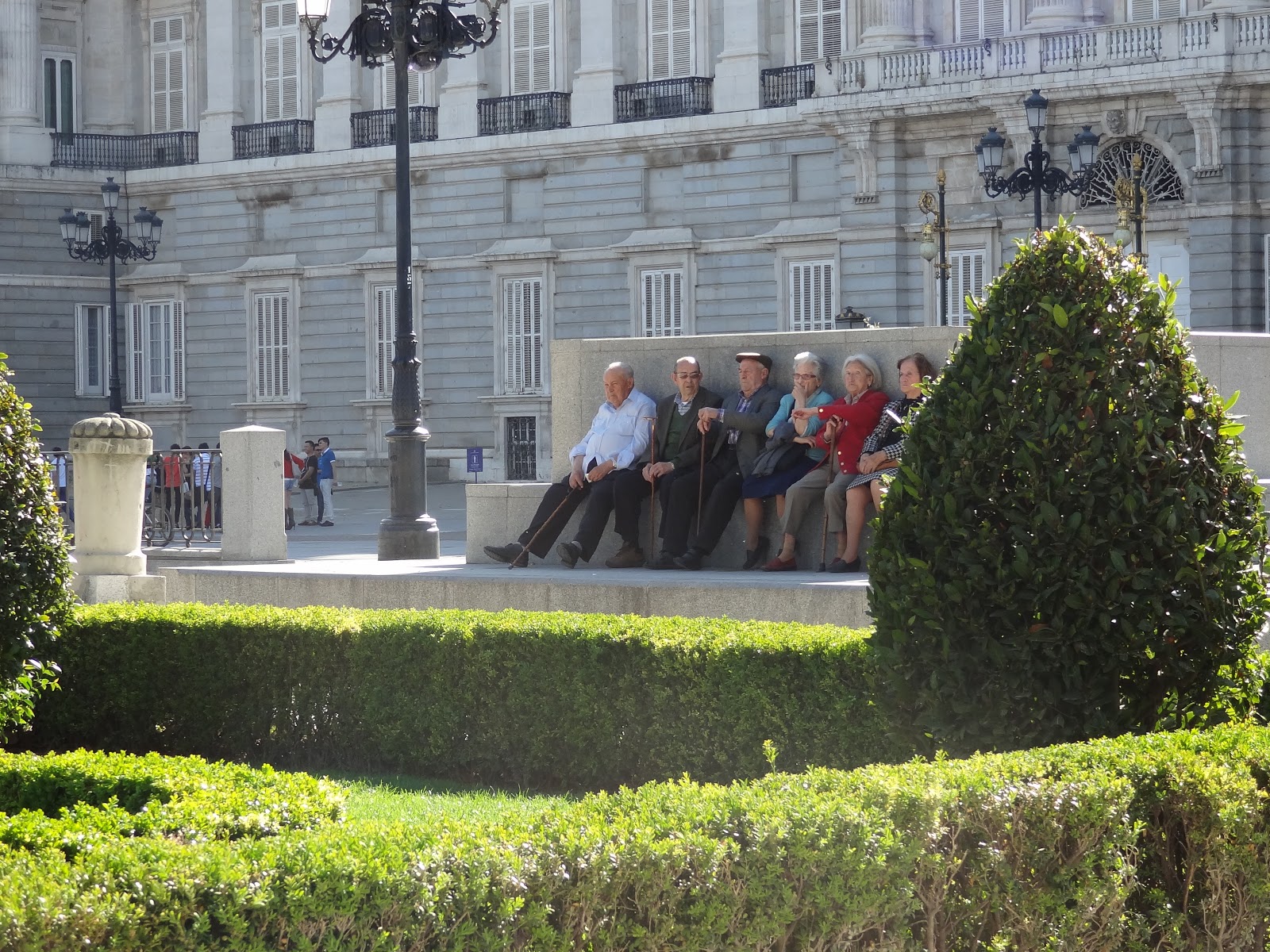
     The next day, we all went inside the palace for the first time— but not before seeing some elderly Spaniards having a rest in the shade. 

(Elders in the shade with the Royal Palace behind)

     The 18th century Royal Palace is enormous. It has over 3,000 rooms, of which around 50 are visible to the public. These visible rooms include the old pharmacy, your usual extravagant bedrooms, a dining room, a lot of expensive dinnerware, a chapel, a matching Stradivarius string quintet (the only one in the world), and paintings by famous Spanish artists. It was impressive and I'm glad I saw it after all this time. 

     One day when I was at school, Katie took mom to one of our favorite museums in Madrid, the Museo Sorolla. The museum is the house where the Spanish painter Joaquín Sorolla and his family lived, and all of the paintings are his. It is a beautiful place and I would recommend it to anyone visiting Madrid for more than a day. 

(Inside the Museo Sorolla)

     Later, I played a few songs at a sort-of political event. The husband of the woman with whom we went to Extremadura has a solar energy company, and his company was signing an agreement with a Spanish 'green' party called Equo. The entertainment they had booked for the evening had to cancel, so I was asked the same day if I could play a few songs after the business was wrapped up. I did. 


(Playing at a political rally?)

     We also made sure Mom visited Retiro park several times. It is the Central Park of Madrid, and is my favorite green space. The trees there had finally started to fill out and the park was great for lounging. 

(A corner of Retiro)

     We made trips to the Prado and Reina Sofia museums as well, of course. My mom's favorite parts of the Prado were the usually less appreciated ancient sculptures and Dauphin's treasure, both of which are found downstairs, far from the crowds. Dauphin's treasure is kept inside an enormous vault, its incredibly thick door letting you know something valuable is inside. The Grand Dauphin Louis was the son of Louis XIV. He was also the father of Philip V, the first Spanish Bourbon king (1700-1724), and his treasure was transported to Spain upon his death. It's mostly comprised of pots, jars, and containers for liquids, though it is far from your ordinary tupperware. These are constructed of jaspers, jade, lapis lazuli, turquoise, onyx, rock crystal, etc. Both the sculptures and the treasure are worth checking out if you make it to the Prado, and are a good break from all of the ultra-famous paintings. 
     The week was filled with great food, as we took Mom to all of our favorite eateries. She had both traditional Spanish food and our favorite 'foreign' food, such as tacos, pizza, and Ecuadorian food. There was also our favorite café, where we had my specially made tea (black tea with milk, honey, cinnamon, chocolate...not so much tea as liquid dessert) and homemade cheesecake with blackberry preserves. One day I'll write on all of our favorite restaurants around town. 
     Our last big trip was to Segovia, which I had gone to in the Fall and enjoyed. Both Katie and Mom wanted to see the Roman aqueduct and surrounding area. What I hadn't done on my first trip was visit the Royal Palace of La Granja de San Ildefonso, just a short bus ride from Segovia, and which was formally the summer residence of Spanish kings, dating back to Philip V. First, we visited Segovia's enormous cathedral, and then walked out of the city walls to see the Church of La Vera Cruz, constructed by the Knight's Templar in the 13th century. When I had tried to visit last time, it was closed, but this time we found it open and went in. It was simple, sparse, and well-built. 

(La Iglesia de la Vera Cruz)

(Inside the church)

     Afterward, we walked up a hill for a view of the castle, then down and around and back up to the city for some lunch. 

(The girls, the castle)

(Lunch in Segovia)

     After lunch we caught the bus to La Granja. This palace is supposed to have awesome gardens, and we thought that they might be in bloom since Madrid had flowered. However, we did not account for the difference in elevation, and found the gardens still very sparse. The trees in front of the palace, however, were worth the trip alone. There was an enormous giant sequoia, 115ft tall and planted in 1877. 

(Trees, the palace— the giant sequoia to obstructed to the right, detail below)

(Giant Sequoia) 

(A view from behind the palace)

     After walking around the gardens and the small town, we took the bus back to Segovia to spend some quality time at the aqueduct before leaving for Madrid. 


     After nine days, Mom unfortunately had to go back home. We had the best time ever with her! She brought the good weather with her and took it back when she left. Madrid didn't see another good week for a month, and it's just now getting nice again. We hope she comes back soon (and brings Dad and Ben along too)!